
If you have ever watched trucks roll down the interstate, most of what you saw were dry vans — the enclosed, rectangular trailers that quietly move the bulk of America's truckload freight. They are so common that many shippers never stop to think about why they are the default, or when another trailer type would serve better.
This guide explains exactly what a dry van is, the freight it handles best, the few things it cannot do, and why — for the vast majority of shipments — it is the simplest, most economical choice on the road.
1. What a dry van actually is
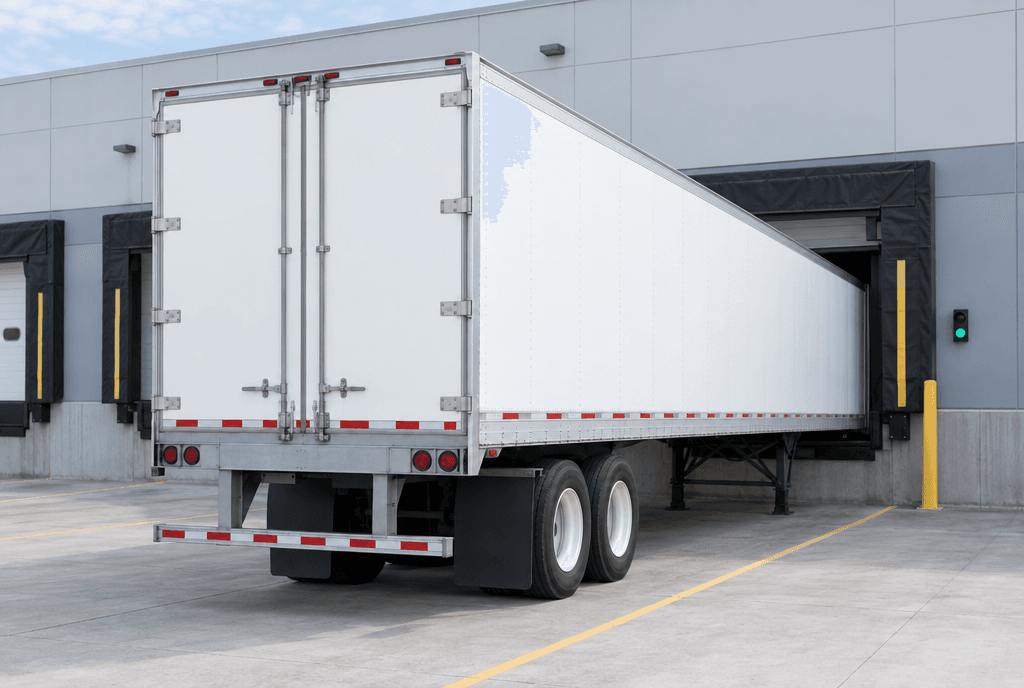
A dry van is a fully enclosed trailer with solid walls, a roof, and rear doors. It protects freight from weather, road debris, and theft, but it is not temperature-controlled — hence 'dry.' The standard unit is the 53-foot trailer, the workhorse of domestic truckload shipping.
Because the trailer is sealed and standardized, loading and unloading are straightforward, most docks are built around it, and a single dry van can carry an enormous variety of palletized or boxed goods without any special handling.
2. What dry vans carry best
Dry vans are ideal for non-perishable, packaged goods: retail and consumer products, paper goods, packaged food and beverages, electronics, building materials, textiles, and the broad category of general palletized freight.
If your product ships on pallets or in cartons and does not need refrigeration or an open deck, it almost certainly belongs in a dry van. That covers a remarkable share of everything that moves by truck.
3. Capacity: how much fits in a 53-foot trailer
A standard 53-foot dry van typically holds around 26 standard pallets on the floor, with a maximum legal payload that generally lands near 45,000 pounds depending on the tractor and equipment. The real limit is whichever you hit first — space or weight.
Light, bulky freight 'cubes out' (fills the space before it hits the weight limit), while dense freight 'weighs out' (hits the weight limit with room to spare). Knowing which applies to your product helps you load efficiently and quote accurately.
4. Where a dry van isn't the right tool
Dry vans have clear limits. They cannot keep freight cold or frozen — that is the job of a refrigerated trailer. They cannot carry loads that must be loaded from the side or top, or that exceed standard dimensions — that is flatbed or specialized territory.
If your freight needs temperature control or an open deck, a dry van is the wrong fit. For everything else that ships enclosed and palletized, it is usually the right one. Uzum Logistics runs a dry van fleet and focuses on the general-freight shipments it is built for.
5. Why dry van is the economical default
Dry van capacity is abundant, which tends to make it the most cost-effective truckload option. Equipment is standardized, drivers are plentiful, and the network of lanes is deep, so pricing is generally more competitive and capacity easier to find than for specialized equipment.
For a shipper, that means matching ordinary palletized freight to a dry van is almost always the simplest way to keep costs reasonable without sacrificing reliability.
6. Getting the most out of dry van shipping
Build stable, well-wrapped pallets that use the trailer's cube efficiently, give your carrier accurate weights and dimensions, and plan recurring lanes with a carrier who runs them often. Those habits turn a commodity service into a dependable part of your supply chain.
If you have steady dry van volume, ask about dedicated capacity — reserving equipment for your lanes delivers more consistent service than booking load by load.
The dry van is the backbone of freight for good reason: it is versatile, economical, and built for the palletized, enclosed goods that make up most of what ships by truck. Knowing its strengths and limits helps you ship smarter on every load.
Have dry van freight to move? Request a quote from Uzum Logistics and our team will help you get it on the road.